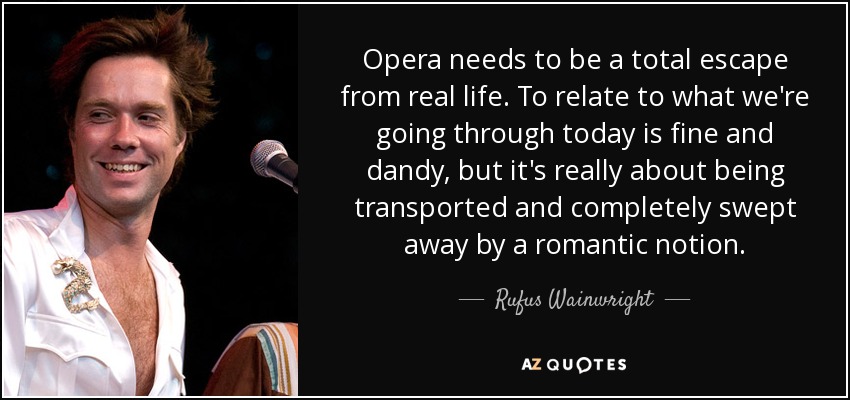
As I ponder the wondrous news that I have managed to secure tickets to see Rufus Wainwright perform his Judy Garland tribute for one last time at the Albert Hall later this month, I thought it would be nice if I jotted down for posterity just how much I love and appreciate his work (and, of course, THAT voice), and discuss his music along with some personal anecdotes - as is my way on this blog - and even possibly encourage some non-fans to go and explore his work. Sometime pleather-clad glam rock n roll star, sometime torch singer, opera writer, cabaret and burlesque inspired performance artist, and all round dandy, there are few genres that Rufus doesn't have a toe tipped in, and his work is a rich, technicoloured tapestry. I first discovered him through his Want 1 and Want II albums back in 2003, and each album was a revelation. His beautiful, emotive voice enraptured me from the first moment I heard it, and the swooning strings, the glorious arrangements and the theatricality and wittiness of the lyrics were like gold dust. This is the first thing I ever heard by Rufus and it was a life changing moment. Just listen to this voice...
- Rufus Wainwright, Agnus Dei
And then there was the first time I saw him perform in concert, which was at the Apollo in Manchester in 2004. From the very first second he started singing on 'Oh What a World', I knew I was in the presence of someone who had been blessed by the invisible hand of the divine. For this live experience was like bathing in sonic honey, purple-hued and jam-packed with feeling. His voice was as rich as velvet and yet, at random moments, would crack and rasp with deep emotion, just like Frank Sinatra's did. The closest analogy I can offer is that I actually felt like I was listening to a pre-Raphaelite painting. And if, as the novelist Thomas Mann observed, all art aspires to the condition of music, perhaps what I actually was experiencing was this idea in full, and, sitting just behind me, the ghostly spirit of Dante Gabriel Rossetti was, unknown to us all, drowning in the glory of his own pictures being turned into ecstatic melody, whilst no doubt making a million observations of my fine lady at the same time so she could be his next portrait study (what a masterpiece that would be). Anyway, it was a supremely magical moment. And Rufus also looked every inch the perfect pop star, for he is a consummate dandy, and you can pretty much rest assured that never will he take to the stage looking like a run of the mill indie singer/songwriter who has just finished doing an oil change on his car. No, Rufus oozes glam and showbiz, darlings, and thank the Lord above that he does!
Another occasion I recall was when I saw him live at Liverpool Philharmonic Hall in 2010, where, surprisingly, he invited fans up to join him on the stage during his encore. Because my CF was particularly bad that day, I couldn't make it onto the stage. But a young man in a deep velvet jacket who looked a lot like your very own Nocturnal Butterfly, did get onto the stage, and my eagle-eyed observation caught Rufus checking him out. Now, dear reader, although I may appear calm and composed in these words, if it had been possible for the world to see the depths of jealousy and fury that my burning heart experienced at that moment, I would imagine that many of you would have to go and have a lie down after witnessing it! Oh, to have been cruised by Rufus Wainwright! Ah, the tears and sighs I emitted in the car on the journey home, and all because of The Man Who Got Away!
But hardly had my love affair with Rufus become established when tragedy struck both him and me, almost at the same time. For both our beloved mothers passed away. Out of this heartbreak came one of his most astonishing albums, All Days are Nights: Songs For Lulu, and it sound-tracked my own grief in a way no other piece of music could. He performed this album in its entirety at the Apollo in Manchester in April 2010, and it will remain in my memory forever as one of the most profound musical experiences of my life. The album consists of Rufus singing whilst being accompanied only by his own piano playing, and this was what he recreated on stage that night. With placards placed throughout the auditorium requesting silence and no applause from the audience until Rufus had exited the stage after the first set, it was clear that this was going to be something very different to a usual concert experience. He entered the stage, dressed in a long black dress with a long train flowing behind, sat down at his piano, looked up at the sole spotlight, paused for a few seconds, before proceeding through fifty minutes of the most heart-wrenching, healing music in a manner that remains beyond my ability to accurately describe. Hearing the songs 'Sad With What I Have', 'Sonnet 20' (with words by Shakespeare), 'True Loves', and the closing, devastating 'Zebulon', are still some of the most sacred moments I have ever had in my life. And although there was talk of many disgruntled audience members leaving the concert and not returning after the interval, I can only say I pity them if this was indeed the case. Rufus was incredibly brave performing in such a naked, vulnerable way, and it helped me enormously with my own grief, and brought me so close to my mum that at times I felt like she was sitting in the auditorium next to me. I suppose many people merely expect to be entertained when they attend a concert. Fortunately, most people attend for the art.
A year or so later, Rufus announced that he was going to marry his partner, Bjorn (see picture above), and incredibly, his timeline was almost exactly the same as mine and my good lady, for we ourselves were just putting the finishing touches to our wedding and the celebrations, after deciding to finally take the plunge after being engaged for almost ten years! We were tying the knot that December 2012, and, once again, Rufus was on hand to soundtrack this most glorious happening in my entire life.
Because of this, one of my deepest, everlasting memories of Rufus is his Out of the Game album, which had been released about a month before me and my fine lady got married, and to ensure I was in as tip-top a condition as possible, my routine fourteen days intravenous antibiotic therapy in hospital was arranged by the consultant, in the weeks leading up to our marriage. Some of the best days of my life, strange though it may seem, were those days I spent in hospital in the week before Lydia and me got married. For listening to that wonderful album, so sweeping and romantic, both lyrically and sonically, in a time of intense anticipation of the magical realisation that I was actually marrying the great Love of My Life in a couple of weeks' time, was actually sublime. It was utterly delicious, and although I desperately wanted the big day to arrive, another part of me would have liked to hold on to that intense feeling forever. There were many, many songs that fitted my elated mood, but perhaps this one was the closest to the mark, containing these fabulous lyrics:
So baby welcome to the ball Don’t worry all about nothing at all I don’t know how you made it in But since you have arrived Let it begin
'Cause something in your eyes has made this room a much more brighter place The chandeliers and fireplaces all seem jealous of your face Something in your smile has left a light that has left a trace Come and take my hand and let you lead me to the promise land
- Rufus Wainwright, Welcome to the Ball
And then, there is his love and knowledge of opera, which, in turn, nurtured my love of opera in turn. I hardly need to emphasise how important a trusted, knowledgeable, guiding hand is when it comes to the myriad, divine world of grand opera, with all its passion, lust, romance and tragedy. And, along with Freddie Mercury, who could be a better Virgil to hold my hand through the dark wood of opera, so savage and harsh and dense, and the thought of which renews my fear, to paraphrase Dante.
And, so, in great anticipation I look forward immensely to next week's concert. How magical it will be. Rufus, with his extraordinary voice, and with an astonishing full band, recreating Judy Garland's famous 1961 comeback concert, which Rufus himself described as being "the greatest night in showbiz." What a dazzling treat it will be, a feast for the ears, eyes, soul and senses. As good as it gets, actually.
Dear Reader, let's face it, if Blur thought this was the case back in 1993, when they released their Modern Life is Rubbish album, it's difficult to argue that things have improved. We've got greater wealth inequality since then, our public services have been all but decimated by a seemingly never ending austerity, we've had a global pandemic which claimed the lives of millions of people, social media has exploded into our lives, dividing people more than ever, and we are on the brink of a global depression because of the war in the Middle East, and, like a sparkling icing on the top, we face the ever closer threat of ecological disaster due to climate change.
Ace. Just bloody ace.
I very recently discovered the work of the artist Rebecca Lightbody, and I responded to her work in a very positive way, as she seems to sum up so much that is fiercely irritating about our culture, but with a dark sense of humour at the same time:
There is something about this particular image that really amused me. Designed in the style of the hundreds of business cards that used to be found in telephone boxes in London, by ladies (and gents) of the night in the 1980s and 90s (and perhaps still do, who knows), but with a fabulous twist: "Call For Pain - I'll send you straight to voicemail." I don't exactly know why but I actually laughed out loud when I read that. For me, it just seemed to sum up so much about our current society. It used to be so very easy, if you wanted something from officialdom, or had a query about a venue or an electronic device you were interested in buying, or wanted to make a doctor's appointment, to just pick up the phone and call somebody. But now, it is practically impossible to do this. You either press the numbers requested when the phone answers, only to reach the end of the options with the instruction to email your question. Or you will be put on interminable hold, with Vivaldi blasting your eardrums, which is then periodically interrupted by a voice saying that the company are experiencing an unprecedented high number of calls, and advising that there will be a long delay. Thirty minutes later you are still waiting and have to hang up as you have other calls to make as well. I don't know about you, dear reader, but I despise this part of our society. And it doesn't have to be like this! It's a choice by the collective people who run the show.
This T-shirt design by Rebecca also caught my attention...
Albert Camus and the existentialists, eat your heart out!
With all this in mind, each day I become increasingly grateful (and reliant) on the simply priceless website that is the Internet Archive. And my latest discovery has really fired my imagination. For, instead of perusing through our dreaded contemporary newspapers or magazines on a weekend, I can now pretend that I am sitting in the lounge of The Cadogan Hotel, in 1896, sipping Earl Grey tea whilst reading The Savoy magazine of literature, art and criticism (which was published by Leonard Smithers and who was a friend of Oscar Wilde), with piano concertos by Chopin and Liszt playing away softly in the background or on my headphones.
I am currently two-thirds of the way through the 1st issue of The Savoy (which was published in January, 1896), and I have enjoyed the articles immensely. Here are its literary contents:
I am eagerly anticipating reading Aubrey Beardsley's Under the Hill, which is the last story in the collection, but so far my favourite has been The Binding of the Hair by W.B. Yeats, which has a strange, ghostly ending that I was not expecting. The piece by Havelock Ellis on the novelist Emile Zola, Zola: The Man and his Work, was intriguing and informative, as was the piece entitled Dieppe by Arthur Symons. This article had extra interest for me as I spent some time in Dieppe circa 1990/91, and although I don't have any recollections of any of the places Symons discusses, it still brought me closer to the time I spent there, and I could feel the warm heat and hear the soft sound of the sea as I read his evocative descriptions.
- Dieppe, Illustration in The Savoy (1896)
I have been enjoying perusing The Savoy as if I'd discovered treasure that had been buried deep at sea for over a hundred years, and, in a sense, that is an accurate description. Of course, this find doesn't make me richer from a financial perspective, but the richness of its contents from an intellectual and emotional standpoint, and the way it has fired my imagination and allowed (nay, encouraged) me to find a way to extend my reality to how I would have felt if I had been living in 1896, has been priceless. To imagine myself reading this rather risqué, brand new decadent publication in the lounge of a beautiful London hotel, whilst sipping Earl Grey tea, in 1896, is an added delight. We all have many possibilities in us, so why not explore those myriad selves if the opportunity present itself? And not only that, it has given me a space where I can ignore some of the things in modern life that I described above which drive me to a barely concealed fury. The other fabulous news is that all eight issues are available to read on the Internet Archive, and I fully intend to make the very most of this situation by leaving the same interval between each edition as I would have had to do when they were published back in 1896, rather than just devouring all eight as soon as possible. A rather dandified and dignified way to go about this particular experience, I would suggest.
Anyway, gentle reader, with that in mind, I am now going to make myself a fine pot of Earl Grey tea, settle down in a chair in the lounge, put a Liszt piano concerto on in the background, and read what's remaining for to me to read in Issue 1 of The Savoy, whilst pretending I'm sitting in the lounge of The Cadogan Hotel, wondering if at any moment Oscar Wilde, Arthur Symons, Claude Debussy, or even Pierre Louys will walk through its famous doors, and join me for tea. Maybe you should do the same?
And yes, in my opinion, modern life is still rubbish.
Last year, I discovered that Max Richter's Sleep had been performed, live, in concert, with the audience members offered beds to sleep on during the performance, which began at 10pm and finished at 8am the following morning. Immediately, this struck me as inspired, and I was rather saddened that I had missed it. When I told my wife about the concert, she came back with an inspired suggestion: we would recreate it at home and have the album playing (the album lasts 8 hours) from 10pm until 8am the following morning. That sounds great, I thought. Let's do it this weekend. The timing was increasingly perfect for us, as the weekend we decided to do it (December, last year), fell on a New Moon, which from a Daoist perspective is the best time to do something of this nature.
With the date confirmed, we arranged our diary so we had nothing we had to do the next day, and made sure everything was done, including all my time-consuming late evening medical treatments, so that we were ready and prepared for bed, with lights out, to start the Max Richter album, Sleep.
At 10pm exactly, I pressed play on Spotify.
Now, dear reader, just to bring you up to speed, I had read some wonderful reviews by people who have listened to Max Richter's Sleep, whether that be on album or the fortunate people who had experienced it live. Almost unanimously they waxed lyrical about how incredibly relaxing it had been, many saying they had experienced the best, most refreshing night's sleep they had had in decades. A few compared it to Brian Eno's ambient albums. Well, let me prepare you in advance: my experience was anything but relaxing and rejuvenating.
During the first ten minutes there was something profound about the feelings that the music created, and I recall my wife and I clutching hands during this time. Gradually, though, we both disengaged our fingers from each other and changed positions as partners do when falling asleep. And then suddenly, in the pitch darkness, memories began to invade my consciousness from many different episodes of my life. And these weren't just fleeting memories. These were intense, and it was like being back in those situations. I saw my life as a boy in the little terraced house in North Wales where I lived until I was seven. Crystal clear memories (more like a lived vision, in all honesty), of things I loved as a boy: my train set, my pet rabbit, train memorabilia that I had collected but which has long gone, my Flockton Flyer book, my uncle, and, of course, my Mum and my Nain and Taid. I recall sobbing and asking them for their forgiveness, asking them if they knew how much I loved them, hoping beyond hope that they did. Oceanic feelings of guilt swept in, leaving me shattered. I hope I returned your love, was about all I could say.
I then recall Lydia woke suddenly and needed a drink, which I helped her to do, and after doing this she very quickly fell asleep again. I knew this as I could hear her gentle purring and feel the change in her breathing next to me.
The next stage I experienced was intense feelings and visions of death; my own, the people around me who I love, even the death of the animals and the universe. I could feel myself breaking at this point, and just when I thought I couldn't take much more, a complete change came about in my thoughts and memories. In what seemed like an instant, I was then recalling vividly some of the most ecstatic and euphoric happenings of my life. Some of mine and Lydia's favourite places, being on stage in Les Miserables, and most intriguingly, memories of mine and Lydia's date nights. But, just then, something changed. It was as if a force, an energy, was trying to deceive me. Deep inside my psyche I knew this was not Lydia making me feel these things, and this knowledge helped me break this particular spell. I managed to force myself to wake and sit up in bed. But, as I lay back down, things became very strange indeed. We have deep green velvet curtains over our windows and it was pitch black in our room, except for a slight chink of light from the speaker that was in the floor in the corner, half hidden by the ottoman. I desperately tried to sleep, changed position a few times, but found it completely impossible. Richter's haunting music enveloped the room and completely invaded my body, mind and soul. In an attempt to sleep - even though by doing this I was letting the side down - I put my headphones on so I could listen to the TV series Auf Wiedersehen, Pet, a tactic which usually works very well. But it was no use. I could hear the bass and haunting singing above the headphones, and the eeriness was utterly overwhelming. I felt like there were spirits in the room with me. In the dark corner by the mirror, the small speaker light was barely shining but I was almost too petrified to look in that direction although my attention was constantly trying to do so. I contemplated sitting up and having the courage to just look brazenly into the darkness and see if anything happened. But I simply could not do it; I could only glance nervously and then quickly away. Once again I swapped positions multiple times. I did some photo art on my phone to try and distract my mind as it was all becoming too much. I was caught completely between desperately wanting to see somebody like my mum, Nain or Taid, yet at the same time being gripped by the fear that it might actually happen. I was terrified that they might be upset with me over the kind of things my mind had been thinking of earlier. I looked at my phone and saw that it was now about 5.30 and I knew that I simply couldn't take any more. I decided I had to turn the Max Richter album off as it was all becoming too distressing and I knew that if I continued there would be no chance of me getting any sleep, and I was already utterly demoralised and exhausted. So I turned what remained to be played of Max Richter's Sleep album off and very hesitantly found the small light on our landing, and turned it on so I could go to the bathroom. I recall thinking how I could never have gone into our bathroom everywhere had all been in pitch darkness, so thank goodness for that small night light. After this, I came back to bed and, eventually, I think, managed a very slight, but restless doze. At 9.40 our doorbell rang (I answered it) and then at 10am (the time Max Richter's Sleep was scheduled to finish) Lydia's alarm went off and she woke up. When I came back into our bedroom, I felt a very real need to open both our windows and let some fresh air in, and Lydia said I must have intuitively known what to do as, through her knowledge of Daoism, that is what she would have suggested. She also asked me to bless the corner of the room that I had found so mysterious and haunting, just to make sure that if there were any supernatural happenings occurring there, especially if it involved loved ones, to let them know that everything was fine and that there was absolutely no bad feeling towards them, and which would also, at the same time, clear the space if unwelcome spirits had been hanging around, which, due to my experience, this was highly likely.
And with that ended my "relaxing and rejuvenating" experience with Max Richter's album, Sleep. I have read many more reviews of this album, and, as far as I can tell, no one who has written has had an experience remotely similar to mine. All of their reviews tell of a similar tale: relaxing, rejuvenating, deeply settling, a spiritual awakening, etc. Lydia, too, remembered very little of the night and had slept very well. But no, this wasn't what occurred with me. My experience had been the complete opposite. It was incredibly difficult at times but I don't regret doing it. Perhaps I conversed with spirits in the otherworld, or maybe I connected in a very profound way with memories that are usually hidden so deep that I can't reach them (or they me). I guess I will never know for certain exactly what happened. But, either way, my experience, when compared with everyone else's, confirmed only too well what I am already painfully aware of:
Although I haven't watched MTV in over twenty-five years, the news of its closing down has had me reflecting on what a sometimes brilliant, sometimes infuriating TV channel it was. I was about twenty when I first saw it, circa 1991/92, and it was a channel I watched a great deal initially, but then turned away from completely around 2006/07. Part of the reason for this was that my fiancée and I didn't have satellite TV in our very first flat, but even before then I had stopped watching the actual channel MTV because there was hardly any actual music on it. The last time I watched it (well, recorded it on VHS at my mum's house, actually, which was then watched over the next few days on our video player) was MTV's 120 Minutes programme, which was on around midnight and during which far more obscure, less mainstream-heavy music videos were played. It was through recording this programme that I discovered the likes of The Long Blondes (see a previous post), The Dresden Dolls, Ladyfuzz, New Young Pony Club, The Bravery, and quite a few other rare gems as well. But this was the last bit of my time with MTV.
It was very different from when I first started watching it, circa 1991/92. Initially, it was, almost inevitably, incredibly exciting. Whenever I had my mum's house to myself I would put it on. And even the videos to some of the songs that were incredibly mainstream were fascinating and well worth watching in those first couple of years. Some of my main memories are of the repetitive nature of a lot of the videos, and it seemed that the likes of Dire Straits, Billy Joel, Yes, Phil Collins, Genesis, and REM must have been included by rota during each passing hour. But even this was great. Dire Straits' Walk of Life' video was hilarious, as was 'I Can't Dance', and 'Jesus he Knows Me' by Genesis. And the video to Phil Collins' 'I Wish it would Rain Down' was actually a masterpiece, and I enjoyed watching that video very much. Here are the links for anyone interested...
Dire Straits, Walk of Life:
Genesis, I Can't Dance:
Genesis, Jesus He Knows Me:
Phil Collins, I Wish it Would Rain Down:
It was also on MTV that I first saw my very favourite promo video (still to this day), and the most heart-breaking one, too. My favourite, is 'I'm Going Slightly Mad' by Queen. In the video, Freddie (who was very ill at this point), wears a great black fright wig, and proceeds to ham it up spectacularly in a wonderfully theatrical, German-expressionism styled video. I doubt if it will ever be bettered...
Queen, I'm Going Slightly Mad:
And, then, there was the devastating 'These Are the Days of Our Lives', which was the last video Freddie ever appeared in, and which was heart-breaking to watch. Shot entirely in black and white, there is no fright wig or costume to disguise how ill Freddie was, just him and the band, performing this achingly beautiful song with class and dignity. The final "I still love you," from Freddie, complete in the original video (see below) that includes him signing out to the viewer, turned out to be his final goodbye, and the first time I saw it I was in floods of tears, as I have been on many consecutive viewings.
Queen, These Are the Days of our Lives:
But the main memory I have of MTV now, when I reflect back on those times, is actually the presenters. There were many of them but three remain in my mind. The first one was Paul King, a kind of laid back, indie "cool" guy who didn't go in for some of the insanely irritating "zany" shenanigans that used to drive me to a fury. The only reason I really remember him is because he introduced an MTV U2 weekend special in 1992, which I was so excited about and recorded quite a lot of. Unbelievably, his intro is on YouTube...
Another presenter that I recall was the exotic, Italian (I presumed), Kristiane Backer. She was rather easy on the eye (and ears compared with some of the brash American presenters!), and was so much better than all of the other female presenters, who were so obviously reading their lines from an autocue, and seemed to have little genuine interest in pop/rock music...
The third one I recall the most, however, Ray Cokes, I remember for all the wrong reasons. He was one of those infuriating, "zany" types, a kind of prototype Chris Evans, or Johnny Vaughan from the nauseating The Big Breakfast programme, and here he is for you to savour (and be haunted by from now on) in all his "glory":
But, all in all, it's a shame that MTV has finished as a channel. Although to most intents and purposes it ceased being an actual music channel many moons ago, it still signals a shift in culture and signifies the end of an era. It accompanied me through much of my early twenties and into my late twenties, and I am very grateful for its existence during those years, not to mention the gratitude I have that my mum was able to have SKY TV so I could watch it.
It was far from perfect, but served a very important pop music lifeline for many years. I raise my glass: to MTV, and the end of an era.
And my absolute Favourite MTV moment, Nick Cave & Kylie Minogue, interviewed, sadly, by Ray Cokes, although both Nick and Kylie lead him on a merry dance, which is fabulous.
As the end of the year, another horror year in geopolitical terms, with wars being waged relentlessly, naked power revealing itself in more distressing ways with each passing month, approaches, and in the hope of maintaining a psyche that is relatively sane, and to attempt to get to the very marrow of life, I have turned, as I always do, to art, literature, music, style, and the non-human world, because, in all honesty, where else can one go? I'm not going to discuss health issues in this post, as any regular (and much appreciated) readers among you know this is a constant in my life, and this year has been no different. But here are a few of the things that have made this year enchanting and interesting, listed in no particular order of importance lest we forget that art isn't a competitive sport.
As an individual who often finds that he has more in common with the culture of the past than the present day, to discover that the entire series of BBC's Play For Today is available on the Internet Archive website was for me a majestic occurrence. I have watched a couple of them, but the one that has had the biggest impact and which was genuinely unsettling was Dennis Potter's Schmoedipus, starring Tim Curry of Rocky Horror fame, in a role that was filmed the year after he had premiered the role of Frank-en-furter in London. It is genuinely unsettling, humorous and toe-curling in equal measure, but also with a big heart. I discovered that the Play For Today series was available because of one of the Hauntology-themed groups I follow, and I am incredibly grateful to them for bringing this to my attention. And this episode has that eerie, Hauntology mood in abundance. If you get the chance it is very much worth watching, and can be found here:
I have studied this utterly absorbing and fascinating play in great depth this year, and it's been one of the most rewarding and richest reading experiences of my life. The icing on the cake was seeing it performed on the stage, which I finally got to do this year. Its exploration of the intense power that desire wields on our world is explored in fascinating detail by Wilde in this play. as the heroine of the title, Salome, brings tragedy untold on the characters because of her magnetic beauty. Salome herself is, also, a revolutionary feminist character, because not only does she inspire fear desire in men (and women), but very unusually for the 19th century (not unusual among the fabulous symbolist and decadent artists of the time, however), Wilde gives Salome her own fierce desire as well, and it is her insatiable desire for the Baptist, Jokanaan, that brings the tragedy to its almost inevitable conclusion. It is an incredible play full of mystery and symbolism, is still controversial even now, and it could be argued that the real star of the play isn't a human being but, that beautiful ever-present mystery in the sky: the glittering moon.
The Government Inspector, Chichester Festival Theatre.
Having missed so many theatrical productions that I would love to have seen, to be back in an auditorium watching plays is a wonderful gift, and none more so than witnessing Nikolai Gogol's hilarious and deeply moving The Government Inspector, which was produced this summer at the Chichester Festival Theatre. Oh, where do I begin? Maybe with the author, Nikolai Gogol. His story is a fascinating and tragic one. Born in Ukraine in 1809, he is perhaps most famous for his selection of eerie, enchanting, and quite devastating short stories, which included The Nose, The Overcoat, and, my favourite, Diary of a Madman. This particular story has a special place in both mine and my good lady's hearts, as in our early courting days we used to sit in bed and I would read this story out loud to her. There are moments of great humour but it is also a melancholy tale. The main character, a typical early 19th century Russian peasant, thinks he is the King of Spain, and as the story unfolds it is hilarious and tragic in equal measure. So Gogol already has a special place in both mine and my good lady's hearts, and to see one of his plays at the theatre was wonderful. The very final scene, after ninety minutes of craziness and farce, saw the cast members all freeze in one position, like a photograph. They held that pose for a full two minutes, and as a lonely violin played wistfully in the background, it was truly one of the most stunning conclusions to a play I have ever witnessed. It was like looking at a portrait, and the sense of absurdity that is human existence was tangible in that moment. We are all in this thing called life, it seemed to say, we are all desperately trying to make our way, guessing about the future, trying to make the right decisions, and sometimes getting it hopelessly wrong. Sometimes all we can hope for is understanding and forgiveness, and it was a hugely human and compassionate way to end the play with.
So, there's a few cultural things that I enjoyed immensely in 2025. Let's hope that 2026, as always, brings us all, to quote Percy Bysshe Shelley, much enchantment of the heart.
It's been a few years since I did a Spotify: Wrapped post on here so I thought I would pop this year's listening on here for posterity. It goes without saying that Spotify: Wrapped is actually a bit of a joke, and more of an advertisement for Spotify than anything else, so I don't take these things too seriously. But it does have its place, and I have found this year's Wrapped to have been a fascinating reminder of my year on Spotify.
The format obviously changes slightly each year, and this time round it had a few 'day diary listening' examples, one of which really stopped me in my tracks. It was from February, when I was an inpatient at the hospital desperately battling another bout of pneumonia that had developed because I had caught a succession of different respiratory viruses. And the memory of one of those days stood before me like it was yesterday.
The report reads:
"The night began with a late-evening spin through Release Radar - Lady Gaga, Fatboy Slim, and Moby all taking a turn - before the early hours drifted into ambient Brian Eno and Claude Debussy."
This is almost like a torch being shined into my life at hospital at night, for around midnight, my third round of daily antibiotics is set up by the nurses, which takes about one and a half to two hours to administer. I can see myself lying on the bed, attached to the life-saving drip, listening to my beloved music which is almost as vital as the intravenous drugs in keeping me going at this point. The ward comes to life at around 11pm, with the nurses coming into my room to do observations, and supper being brought in, so I am relatively awake when the IVs are hooked up. This will have been the time when I listened to the Release Radar, and it's a pity there isn't a bit more detail about this, actually, as I have discovered some spectacular new music this year that isn't featured on Wrapped. And, then, of course, as I near the end of the IVs being administered, tiredness will obviously be increasingly kicking in, and that's when Eno and Debussy will have taken over, probably humming gently away as I drift in and out of sleep during the night.
"By midday, Pulp, Suede, and Roxy Music took the baton, with Manic Street Preachers holding the stage from afternoon through evening."
My morning IVs are administered at 6am, so at some point I will have awakened enough to want something a little bit more up-tempo than Eno and Debussy. And I can see myself, listening to my favourite, obscure Pulp, Suede and Roxy tracks, absolute wonders of the universe such as 'His 'N' Hers', 'Your Sister's Clothes', and 'Seconds' from Pulp. Suede would have been my first actual listen of the morning, I would imagine, especially the majestic 'Dawn Chorus', as the beautiful pigeons outside my hospital window will have been the first souls that I will have had the opportunity to connect with that morning, and this hymn always brings me closer to my feathered friends, along with the magisterial 'The Fur and the Feathers', and the rousing 'That Boy on the Stage.'
At some point, I will have finished breakfast, and been attended to by the physios for my first intense session of airway clearance physiotherapy of the day, which usually takes between 45 minutes to an hour. And with this being Release Radar day it means it's a Friday morning, which also means ward round when I see the consultant. And in that strange space in between seeing the physio and the consultant, I can see myself disappearing into Roxy's dreamlike, decadent world of art and icy glamour, and I can recall only too well from experience that it will have been 'Flesh and Blood,' 'Eight Miles High', and 'No Strange Delight', that will have been savoured more than once.
And then, following my meeting with the consultant, is the place where my beloved Manics are called upon. There are times when it seems that it's only them that can do whatever it is that my psyche so desperately needs, so it makes perfect sense to me that this would be my listening for the main part of the afternoon and the early evening, in between the many distractions of different people coming in to see me (i.e., my second round of IV antibiotics, second round of physio, the psychologist, the dietician, the CF nurse specialist; the schedule of my days in hospital really do need to be seen to be believed, and to think some well meaning friends of ours always show their concern about me "being bored" when I'm in hospital. If only they really knew).
There are a couple of other interesting (and rather terrifying for me, personally) diary day recollections that make perfect sense to me looking back. I had many ups and downs during that winter admission and at times it was looking very serious indeed, and by consulting my actual diary, I have managed to piece together exactly what was happening on two other different days in February, and they tell their own story:
My most listened to album was Antidepressants by Suede, and it has been an incredible year for two Suede-girls like me and my wonderful wife. Not only did we get the new album, but it was post-punk inspired and Suede did a run of events in their wonderfully titled 'Suede: Post-punk Pick ups at the Southbank Centre' in September, some of which we were fortunate enough to attend. The highlight was a dream concert, which will live in my memory for as long as memory lasts, featuring a full orchestra, the exquisite Paraorchestra. We have rarely had a September like it, and after missing out on so much from 2020-2024 because of the pandemic, and seeing pictures and videos of our friends and acquaintances having the time of their lives, at various concerts, including Suede, to be able to finally see them again in concert ourselves was truly a gift from the gods. And they played 'Dawn Chorus' with the Paraorchestra as well. Oh, be calm my ever-trembling heart.
As you can see, there is a rather unusual (for me) album at number 4, as I really don't consider myself a big Elton John listener. But there is quite a story behind this. I have a wonderful pen friend who wrote to me frequently whilst I was struggling in hospital, with many suggestions for music that I might be interested in. And one of her suggestions was 'I Need You To Turn To' from this live album, which had been recorded in Melbourne with an orchestra in 1986. Now I had actually purchased this record circa 1988/89, from a second hand record shop in Chester, because at that time I was discovering the unique power of pop/rock music when combined with an orchestra. Queen and Freddie Mercury had been my main opening to this, and although Indie (The Stone Roses, Happy Mondays, etc) was now in an unstoppable ascendancy, it left me cold, and I wanted something far more dramatic, sweeping, and sophisticated. And, on a whim, and swayed merely by the description on the album sleeve, I took a gamble on Elton's Live in Australia double album. It blew my mind. But after a year or so I must have stopped listening to it, and the memory of it all but faded as new life experiences and new music and art entered my world. But when I received the lovely email from my friend with the suggestion of not only this song, but the actual live version that I had once owned, it sent my memory into overdrive. And then, for the first time in over thirty-five years I listened with joy and deep emotion to 'I Need You To Turn To', and then, obviously, the entire album, and I am delighted beyond measure that it is now back on my radar. I know many people really can't get on with Elton, and, believe me, the things of his that I listen to are very small in number, and Live in Melbourne is the only record of his that I have ever owned, but maybe give this a go, and if you can, listen without prejudice. It really is quite beautiful, as is the entire album.
It's absolutely no surprise to me, though, to discover that my most listened to pieces of music this year have been by the divine Claude Debussy. His gorgeous, breath-taking music forms a big portion of my Coffee & Poe playlist, which I love to have on not only when I can give it my undivided attention, but also whilst I am reading or whenever life's stresses are getting too much and I desperately need something to calm my trembling heart and nerves. Chopin, Gabriel Faure and Erik Satie also feature heavily on this playlist, but it's Debussy that has taken the crown of my most listened to tracks of 2025.
And so, that's mainly it for 2025. Chart Music, once again, was my most listened to podcast, and a biography of Oscar Wilde is the audiobook I have listened to most, although I don't listen to audiobooks often as I prefer to actually read (darlings), and I am actually surprised it isn't Duncan Ferguson's autobiography, Big Dunc, that was my most listened to audiobook this year, as my good lady and I listened to his hilarious and astonishing life stories, delivered in his incredibly rich Scottish accent whilst we were doing home IVs over the summer.
"... Bang!"
But it's Suede that will be my main musical memory of this past year. The year when they released a fabulous new album, and my good lady and I were finally able to reconnect with them in concert after four highly distressing years away from these secular religious occasions that we adore so much.
Last week I attended the splendid play, New Dawn Fades, written by Brian Gorman, at the Bloomsbury Theatre, and which tells the story of the band Joy Division. Although Joy Division were essentially a modern post-punk band, and their influence is monumental, for me personally they have always existed in a shadowy timeless, past-not-present realm. Unlike other post-punk bands that I have grown up with and love, such as Magazine and Simple Minds, Joy Division were always a ghostly entity due to the suicide of singer Ian Curtis in 1980, aged just 23. I was a mere lad of seven when they released their first record, and had not even turned ten when Curtis died, so it wasn't until a few years later after they crossed my path, and even then it took a few years more before I was able to listen to them properly, as my just-become a teenage self was simply too petrified of the entire aura of the band's sound and aesthetic, and even hearing 'Love Will Tear Us Apart' made me feel like I was being pulled into some kind of vortex. A similar thing happened to me with another band I would grow to love but which on my first proper listen scared the life out of me: The Smiths. I remember I had loaned the Meat Is Murder album cassette from the local library but when the title track came on I had to stop playing it. The grinding, inhuman mechanical sounds at the start of the song and Morrissey's soul-piercing, accusatory words were simply too much for me. I recall almost trembling with fear and guilt as I stopped the tape and replaced it with something else as it was just too unsettling and upsetting to listen to. I was aware of animal rights and despaired of and despised the way humanity treated its non-human animal cousins, but I just wasn't ready at the age I was to listen to this monumental, challenging work. And the same was true with Joy Division.
I was also been appearing in Les Miserables and sharing a stage with some of the finest singers on the planet, and the world of musical theatre was an absolute obsession at this point, and I think it's fair to say that post-punk didn't really fall into this category. But as I grew into my late teens and early twenties, and as the harsh realities of life kicked in and chronic illness, loss, grief, and anxiety increasingly entered my life, as it inevitably does for everybody, post-punk soon spoke directly to my soul. And the hypnotic dark art of Joy Division suddenly made sense.
One of my greatest CD purchases, still to this day, is the Joy Division box set, Heart and Soul, which I clearly remember purchasing in one of my favourite record shops in Soho on its release in 1997. The box set's four discs included pretty much everything they had ever recorded, but in that pre-digital, internet age (well, for me, anyway), the booklet it contained was almost as invaluable as the music itself. It had a fascinating discography, but far more important for me was an extended essay by Paul Morley, which was like gold dust at the time as a key in helping to unlock some of the mysteries contained within this haunting, quite devastating music. This compilation was my real entry point into the world of Joy Division, and having also watched the Joy Division film/documentary (2007), as well as Anton Corbijn's Control (2007), numerous times since then, this path has now led me to the play, New Dawn Fades.
The play itself was intriguing to witness, and because it's still relatively early in my re-emergence from almost three years of shielding, a trip to the theatre is a most cherished occurrence (it always has been, but even more so since the pandemic). I didn't learn anything I didn't already know, but it was a real pleasure to watch the actors bring the band and the people around them to life. But the real icing on the cake of this production, however, was hearing the four main actors playing a smattering of the band's songs. Obviously, I never got to see the actual Joy Division play in concert, and the closest thing I experienced was seeing a Joy Division tribute band over twenty years ago at the Limelight Club in Crewe. And I really do have to give the four principal actors great credit here, as they summoned the sound and spirit of Joy Division with great accuracy, and to hear them performing 'Dead Souls', 'She's Lost Control', 'Transmission', and 'Love Will Tear us Apart' brought a chill down my spine. Josh Lonsdale, in particular, brought an uncanny, eerie resemblance to Ian Curtis, in both voice and physicality. There was also a small exhibition of Joy Division/New Order, post-punk memorabilia in the foyer of the theatre, and to see and touch the very guitar (a vox phantom VI special) that Ian Curtis had performed in the very famous 'Love Will Tear us Apart' promo video was a very moving experience. It was clear from witnessing other people's reactions to these treasured items that they have the power of religious artefacts. They certainly did so for me.
A night at the theatre is always a great pleasure for me, and this new play was a delight to witness.