Tuesday, 31 October 2023

Anactoria


""The witch is at once female divinity,
female ferocity, and female transgression.
She is all and she is one.
The witch has as many moods,
and as many faces as the moon.
She is the intuitive, seeing and hearing things others do not. 
Most of all she is misunderstood."-
 Kristen J. Sollee

"Yea, thou shalt be forgotten
Like spilt wine,
Except these kisses of my lips on thine
Brand them with immortality."
- Algernon Swinburne, 'Anactoria'

Happy Halloween, darlings.
As always, Bites & Kisses!!
- xx -


Friday, 29 September 2023

Harvest Moon


"Whiles all the night, through fog-smoke white,
Glimmered the white Moon-shine."

- Samuel Taylor Coleridge,
'Rime of the Ancient Mariner'

Saturday, 23 September 2023

The Tiresias Question

"Once, with a blow of his stick, he had disturbed two large snakes mating in the green forest, and, marvellous to tell, he was changed from a man to a woman, and lived as such for seven years. In the eighth year he saw the same snakes again and said ‘Since there is such power in plaguing you that it changes the giver of a blow to the opposite sex, I will strike you again, now.’ He struck the snakes and regained his former shape, and returned to the sex he was born with."
- Ovid


In Book III of Ovid's Metamorphosis, the god Jupiter, and the goddess, Juno, are happily drinking and chatting, when they suddenly come across the subject of sex and sensual pleasure. This conversation escalates and before long, the two of them are in high-disagreement about whether it is men or women who derive greater sensual pleasure (voluptas) around love, sex and sensuality. Jupiter maintains that it is Juno and women who have the greater pleasure, whereas Junos disagrees with this. To ascertain for certain, they call on Tiresias, who was a man who had once been punished by the gods for hitting two mating snakes with a stick by suddenly being turned into a woman, and had lived that way for seven years before he was then changed back into a man again, and so, as Ovid describes, "has known Venus in both ways." (It's not about to get much better for Tiresias, either). Tiresias confirms Jupiter's contention that, in his direct lived experience, it is indeed women who derive the most pleasure from love and sensuality. Angered that he has revealed this truth, the goddess Juno then suddenly blinds him as punishment (I told you it wasn't going to get any better for Tiresias!)

I've been thinking about this story quite a lot, recently, as, in a way, I have had a kind of Tiresias experience myself, although not around matters of gender and which sex finds sensual pleasure more enjoyable, but more of a lived experiment around a hugely interesting aspect of Ancient Chinese Thought. As some of you who have read my blog may recall, in terms of Ancient Chinese theory, I am a Yin Fire. This means that my energetic make up is principally composed of certain traits which are typical to Fire types: i.e., I am energetically more healthy and happy when I have things like connection with others, performativity and art in my life, fun, sensuality and Romance. The key concept here is Joy, as that is in fact the over-riding element of Fire. But, as well as Fire types, there are also four other elements as well: metal, water, earth and wood. And I, like most people, have lesser elements as well as the dominant one, which in my case is Fire. But because I have been on a very high dose of steroids for the last six weeks because of my latest CF health issues, I have experienced something which I'd not really been aware of before: the Wood element. And let me tell you, dear reader, it's been quite a revelation!

So, whereas my Fire element is in its fullest flow when it involves the things I have just listed above, the Wood element is rather different. And, to be honest, especially when I was on the highest dose of steroids for the first month, I felt like I was starring in an episode of The Invasion of the Body Snatchers as I could hardly recognise myself or the way I was now responding to the world.


For Wood personalities have very different energetics to Fires, and here are a few of them:

No. 1:
They are morning people ("...oh, the horror, the horror! Only dull people are brilliant at breakfast!)"


No.2:
Irritable or Angry


No. 3:
They struggle to find the correct posture between confidence and arrogance (it's a fine balancing act, dahlings!)


No.4:
Frustration


And, to my huge surprise, I have been feeling all of these things to a degree that I have never experienced before. For the first two months of the steroid treatment, my sleep has been so affected as to have left me pretty much sleep deprived. I have found it much harder to get to sleep and have been waking very early in the morning and found it pretty much impossible to get back to sleep again. This has led to me feeling increasingly snappy and irritable, and although I think I have side-stepped the confidence/arrogance part of the wood element, I have also felt increasingly frustrated, and this is one of the areas that I have found most interesting to ponder. For it's not only my frustration at the huge change that Covid being in the world has brought to my life - in that I still have to be very careful and do everything in my power to not catch it, as I am still clinically extremely vulnerable to it - but I've also been feeling really deep-seated frustrations that go back decades. I had to give up my beloved professional singing and acting career when I was in my mid-20s, and although it was heart-breaking for me and I felt the loss terribly, there were at least other things to soften the blow. I was able to sing at open mics when I felt well enough; I had friends I could go out for a drink with, and I also met my Delectably Fine Lady a few years later, and we had a lovely circle of friends and attended many incredible concerts and events, and I even managed to study for a BA Hons cultural degree, which was a wonderful experience. But now, because of Covid, very few of these things remain open to me. I haven't sung in public since February 2020, and now autumn is here and winter is also lurking just a couple of months away, I won't get any opportunity to do so until next Spring at the earliest, when hopefully there will be some outdoor open mics I can attend. I have had a handful of catch ups with friends this Spring and Summer, but they were few and far between, and now it will be back to isolation as the temperature will be too cold to sit outside until next April. And as for concerts and events, well this is really in the hands of the gods. And at some point I may well have to decide: do I refrain from attending concerts and going to the theatre for the rest of my life, or do I take a chance, knowing that if I caught Covid at one of those events it could be very serious indeed. It's quite a conundrum. And my god do I despise whoever or whatever brought this virus into the human population, probably because of humanity's despicable attitude to the non-human, animal world, as well as the appalling response from the various governments once it had started spreading around the globe. I do, thank goodness, have my Lady to share my life with, but I would imagine that every single couple that has ever been or ever will be would struggle to not find a strain on their relationship if they were in the same situation as us. There are so many life experiences that we could have had if Covid hadn't happened. But, I guess, I have to let that all go, for contemplating that with too much thought is probably where madness lies, and mental health is rather precarious anyway in this fucked up world we have created, where we are busier than we have ever been, and are pretty much being forced to exist in a state of frenetic activity, yet not really achieving anything at all, (described as non-stop inertia by Ivor Southwood), and where we are more connected than ever because of technology, and yet, in reality, have never been more isolated from each other as communities vanish, and we all just stay within our little bubbles and watch Netflix rather than making the effort to genuinely connect with others. And this, for a Fire, means to be forced to sail on very tempestuous waters indeed. But all this bring me back to the original Tiresias Question, and from my direct experience, who has the richest experience of life, fires or woods?

Well, I'm sorry if this offends any wood types out there, and I hope some woody maniac doesn't do a Juno on me, but I wouldn't swap being able to experience this life as a Fire type for anything. Although business type personalities have monopolised our society with their own values (I bet most neoliberal capitalist CEOs/Tory politicians/Right Wing Think Tank robots are all wood types), there is no way they will ever persuade me that their approach to life is the best. "You can cut off all my fins but to your ways I will not bend... I'll die before I let you tell me how to swim", as another sensational Fire, Prince, so devastatingly wrote in 'Dolphin'. 

So there we go. In my experience, the Fire type wins, hands down. And as Tiresias knew, the Fire element is far more feminine than wood, so who am I to argue with one who experienced life as both sexes?

Until Next Time, etc...


Friday, 21 July 2023

Once and Never Again: Remembering The Long Blondes


I can recall with all too much clarity the day I turned on the PC in 2008 and discovered the sad news that one of my favourite bands of that time, The Long Blondes, had split and separated due to the ill health of their guitarist and chief song-writer, Dorian Cox.

It saddened me then and it still saddens me to this day.
During the dark ages of grunge and Britpop, from the early 90s onwards, I was constantly mocked and derided by my friends and acquaintances for "living in the past". Stinging accusations of not being open enough to new music, and of being "behind the times", were regularly thrown in my handsome face. I was dismissed as a dinosaur relic clinging to the memory of former times when, I maintained, bands looked sensational (they mostly did!), synthesisers were a key instrument and the singers had glamour and mystique, and, in the main, could actually sing in tune. My defensive protests that it was the dull music, horrendous (not to mention ugly!) singing, and macho, boring style that I disliked (the Manics, Suede and James, of course, were my life-saving, glorious exceptions), and not the fact that it was contemporary, fell on resoundingly deaf ears and this situation became something of a never-ending in-joke amongst my inner-circle.

Knowing that musical styles invariably go around in cycles, however, I knew that if I bided my time and maintained the faith of my deeply held aesthetic values, new bands would inevitably come along that left the dullness of the likes of Oasis, Embrace, and Nirvana behind, and which embraced the glam, drama and euphoria of the 20s, 70s and 80s.

And then, in 2003, I was going through an overnight recorded VHS video of MTV's 120 Minutes programme, when, to my eternal delight and surprise (not to mention vindication!) everything that I had been waiting for was encapsulated in one, two and a half minute song, that was on the VHS tape I was painstakingly making my way through, in the hope of finding a hidden diamond in the indie landfill that took up so much time and tape. It was a song by a band called The Long Blondes called 'Separated By Motorways', and it was unbelievably catchy, had a lyric full of biting wit, and the band were so gloriously flirty (especially singer Kate Jackson) that it was like being catapulted back to the days of being introduced to sultry pop divas such as Blondie and witty lyrical storytellers such as Jarvis Cocker.

The Long Blondes - 'Separated by Motorways':
https://www.youtube.com/watch?v=F9-01tGGIfY

Of course I immediately hunted high and low for information on them, discovered they were from Sheffield, had an unhealthy (which can only be a good thing) obsession with Pulp (definitely a good thing!), and incredibly, were unsigned. And furthermore, by a wonderful stroke of luck, whilst I was going through another video I'd left recording overnight, I found another of their songs, this time the equally fabulous 'Appropriation.' The promo to this song was, if anything, even better then 'Separated By Motorways,' with Ms. Jackson looking utterly ravishing in knee-length boots, miniskirt, fishnets, and trademark neckscarf. The song itself was absolutely charming, and had that wonderful playfulness that I felt was so lacking in most bands during the 90s.

The Long Blondes - 'Appropriation':
https://www.youtube.com/watch?v=N-NdjBr9rYA

It was only a matter of time before they got more recognition, and this duly came. They were snapped up by Rough Trade Records, released their debut album, Someone To Drive You Home, and deservedly began to get far more exposure from the music press.

During this time, I was fortunate enough to catch them in concert quite a few times, and as good as their album was, this was where they really came to life.
- Long Blondes' singer Kate Jackson

First and foremost, Kate Jackson was a superb front woman. Sultry and stylish, she simply oozed that star quality that can mesmerise an audience. With a perfect pop voice that could handle three minute up-tempo ditties and yearning ballads with equal aplomb, her charity shop glam style fitted the lyrics perfectly. The band behind her were sometimes inspired, sometimes shambolic, but this just seemed to heighten their uniqueness. Their punk spirit and ethic really came through at this time, and the early concerts I witnessed were a delight.

In 2008 they released their second album, "Couples" , which showcased a band growing in confidence and ability. The 80s sound took centre stage on this release, and songs like 'Guilt 'and 'Here Comes The Serious Bit' were as good as anything that they'd released up to this point.

Another aspect of The Long Blondes that I loved was their brilliant B.Sides. Whilst they excelled at catchy, three minute pop songs, their B.Sides showed a band equally happy with brooding, even menacing epics.

The Long Blondes - 'Fulwood Babylon':
https://www.youtube.com/watch?v=a4FLoBwBf4Y

In fact, one of The Long Blondes' main attractions was the high quality of their lyrics. Always sharp and witty, their songs also came laced with a tint of melancholy, and Jackson's knowing delivery of these kitchen-sink style dramas added genuine poignancy.

All this just adds to my sadness that such a promising band, that were surely destined for greatness, suffered the devastating consequences of ill health, and, sadly, I know only too well what health, or rather, the lack of it, can do and I wish Dorian and the band all the very best in the future.

As for The Long Blondes, I'm just delighted that I discovered them and have their precious songs and experienced them in concert when I did.

Summing up, I guess I would have to conclude that The Long Blondes' star may have been brief, but boy did it shine brightly.

And as a personal footnote, they, along with the likes of Sohodolls, Dead Disco, Huski, IAMX, Bat For Lashes and countless others, who were waiting in the wings to offer their magic to the world, as the musical style that I appreciate and connect with, did, as I had predicted, come around once again, had helped to put that despicable mistruth constantly repeated by my contemporaries about my apparent lack of appreciation for "new" music to be unceremoniously discarded, once and for all. I who never doubted, darlings!

However, my dream ticket of seeing them support the Manics will never materialise (what a glam fest that would have been!) but they have left a lasting legacy with their two fabulous albums, that will no doubt inspire many other bands and writers in the future.

They are sorely missed.

                           "Once and Never Again."


Sunday, 16 July 2023

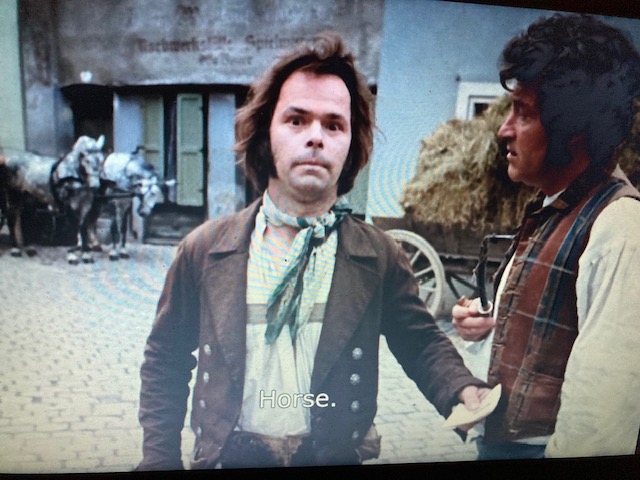
"Horse": The Enigma of Kaspar Hauser


Warning: contains spoilers.


Having just re-watched Werner Herzog's 1971 film, The Enigma of Kaspar Hauser, for the first time in over twenty years, I am reminded why I have always maintained such a fondness for this slow moving and strangely haunting film. Loosely based on a true story, the film centres around Kaspar Hauser, a young man who has been kept locked in a tower for his entire life, until he is suddenly taught a few words, instructed how to stand up and walk, and then released into the world by an unknown man, with only a strange letter of description in his hand that can be read by whomever he happens to come across.


It is an unsettling film, and for much of the story it is obvious that Kaspar (superbly played by Bruno. S, a travelling musician that Herzog discovered and who, as well as never having acted before, had also spent episodes of his life in mental institutions) has more in common with the animals who are also tied up and sleep on straw, than any of the human beings he comes to interact with. After Kaspar attempts to flee from performing in a circus (in order to "pay his way," you understand) he is taken up by a kindly man from the middle-class, and he and his family (staff) try very patiently to teach him the ways of society. But Kaspar finds he simply cannot find his place in this utterly odd, bizarre world.


He is questioned relentlessly by religious folk, but he has the innocent wisdom of a child, and he is scolded when he responds to their enquiries and demands.


They demand faith, but to his uncorrupted, wise mind, this is nonsensical. Later, he is drilled by a teacher on logic, but, again, Kaspar simply finds
their ways and attitudes berserk and incomprehensible. His is a supremely intuitive intelligence and knowledge, and they are as far from understanding his intuitive wisdom as he is of theirs. When he is being questioned by a rich family from England on what his imprisonment was like, he shocks everybody with his response to their questions:


Later in the film, Kaspar is assaulted, it appears by the man who had released him from the tower, possibly his own father, and then towards the end of the film, stabbed and killed by the same man. It is an unfathomable and enigmatic ending to a very strange film. There are moments of genuine beauty and sadness, but what struck me on this watching was just how comical it also is. The early scenes where Kaspar is being taught to walk and speak are very humorous. And when he is learning to speak, his lack of knowledge of language gives the dialogue a distinctly surrealistic feel, such as when Kaspar continually blurts out the word "Horse!" at completely inopportune moments, and answers in the way he does because he hasn't remotely understood what was being asked:


It brings instantly to mind the strange feeling and understanding of dream conversations.


The music in the film also emphasises the mood, and from the very first opening bars of Johann Pachelbel's Canon in D Major, we know we are in for an emotional couple of hours, as the narrator of the film, over this sweeping, dramatic music, asks the viewer:


Kaspar learns to love music, and his conversation about his failure to be able to play the piano tugs resolutely at the heart strings...


In a later scene, Kaspar also flies from church because of the resolutely unmusical noise of the congregation...


I understand Kaspar only too well in this painful scene, as that is how I feel when Oasis or The Stone Roses are within hearing distance of my sensitive ears!


The other thing that really struck me whilst viewing the film this time around was the heavy influence of the German Romantic painter, Casper David Friedrich (1774-1840). Friedrich painted extremely haunting pictures of nature, along with portraits showing humans often isolated against the sublime elements. Herzog clearly has these pictures in mind with some of the scenes in Kaspar Hauser.

And, finally, what a brilliant and emotional watch The Enigma of Kaspar Hauser is. It shows us just how artificial and absurd many human beliefs and interactions actually are, as the innocent and naïve Kaspar illustrates in his failure to comprehend some of the very basic religious and philosophical ideologies and beliefs that our society has agreed to rely on and accept as truth. Kaspar is suspiciously viewed as the animal or barbarian by the townsfolk he engages with, but he is gentle and kind, while they are the ones who tease him and try to make him perform mental gymnastics so they can instil their way of seeing the world onto him. Kaspar Hauser could almost be read as a symbol of all outsiders who can't find a place in this world and who see through the lies and machinations that are the oil that turns the wheel of our hypocritical, late-capitalist society. In this regard, he also put me in mind of Prince Myshkin in Dostoevsky's novel The Idiot, another naïve character who finds himself thrust into the everyday theatre of human affairs, and who ends badly. Indeed, Kaspar has more connection with, and is closer to, the poor animals who are tied up, housed in stables of straw, and generally reduced to the status of non-sentient things, which is how humanity treats the vast majority of non-human life forms it interacts with. There is a beautiful moment in the film that captures Kaspar's close affinity to the animal world in a scene where he is attempting to feed a small chick, and is delighted when it finally takes some of the food he is offering from a stick. Kaspar makes a childlike sound of genuine delight when this happens, and this treasured moment highlights Kaspar's humanity with genuine poignancy. 

A beautiful, haunting and thought-provoking film.


Until next time, I remain,
Your Nocturnal Butterfly.


xxxx

Tuesday, 25 April 2023

Antony & Cleopatra (A Photo Essay)


"Antony and Cleopatra can be read as the fall of a great general, lured away by a treacherous strumpet, or else it can be viewed  as a true celebration of transcendental love."
- A. P. Rierner


"Here you shall make acquaintance with Cleopatra, 
that Being of Flame whose 
passion-breathing beauty 
shaped the destinies of whole Empires."
- H. Rider Haggard, Cleopatra


"Since Antony clearly does not understand her, 
are we likely to do any better?"
- Harold Bloom


"Shakespeare's Antony and Cleopatra must needs be
 intolerable to the true Puritan."
- G.B. Shaw


Whilst studying some astonishing works of literature and art for my dissertation in 2012/13, which explored the question of whether the image of the femme fatale in mid to late 19th century literature and art was empowering or repressive to women, there was one historical and fictional character that began to emerge with increasing regularity in my research, and this person/persona soon began to take on mythological status in my ever enquiring mind: Cleopatra. And then, to my eternal delight, about seven or eight years ago, I was able to undertake a mesmeric in-depth study of Shakespeare's magisterial play, Antony & Cleopatra, and truly inspired, got the idea to do a set of pictures that I could use for my Artist of the Month series that I'd been invited to do at our wonderful, local vegan cafe. My exhibition piece was a great success, and, due to the huge enthusiasm with which it was received, I thought it would be more than appropriate to write an accompanying blog post to describe the relevance of  the pictures that I took, and discuss the extraordinary amount of criticism that has been penned, not only about Shakespeare's magnificent play, which will never diminish in power, but also the magnificent character/persona of Cleopatra herself. Dear reader, if you are unaware of this play, I can confidently assure you it is a mesmerising, glamorous, romantic, and utterly devastating piece of literature.

Shakespeare's version of Antony and Cleopatra (their story has been written by many other writers, too), tells, in principle, the story of the fiery, passionate relationship between Antony and Cleopatra, approximately dated as being around 30 BCE, with the backdrop being the unstable, tumultuous relationship between Egypt and Rome. Over different periods of history, Shakespeare's Cleopatra has been viewed in many different ways. In former times, she has been described as a gypsy, a strumpet, a slave, a royal wench, a boggler, and, my absolute favourite, "a lass unparalleled," which makes her sound like a Disco Queen from Dewsbury, swigging pints of Boddingtons bitter whilst driving all the boys (and ladies!) wild with her flashing, kohl-lined eyes, low-cut sparkling mini-dresses, and flirty dancing. But, over time, and especially in more recent years, Cleopatra has become something of a feminist icon. Instead of seeing her through some of those insecure, sometimes misogynistic spectacles I have just described, she is now often viewed through a different lens. Actors and artists now portray Cleopatra as a thoroughly modern woman, one who is sharp of mind and wit, resilient rather than soft, and one who is in possession of immense intelligence, and who is a skilled diplomatic communicator, rather than the one previously viewed as being little more than a creature dominated by uncontrollable and overwhelming passions. The more modern view also sees her as an exploration of sensuality as power, and I'm pretty sure James Brown would count her among those who he celebrates in his song 'Hot Pants', i.e., one of those fabulous ladies who are courageous and sassy enough, especially in a patriarchal society where the odds are already stacked against them, and who, just like our enchanting queen, "use what she got to get what she wants." Amen to that! This more favourable, contemporary view of Cleopatra also places her as a key player in challenging the notion of strict gender roles and of playing with identity. And, I would suggest, Shakespeare actually did even more than this. For in his play, what he is really demanding of the reader/viewer is that they take sides in what is primarily a struggle between two very different approaches to life.

 On the one hand there is the way of Imperial Rome. This is a male world, governed by strict rules, centred around the conquest of the natural world, waging war and invading other territories, and with an emphasis on individual discipline and duty. On the opposite side is the world of Cleopatra and Egypt: a soft, feminine space dedicated to the senses, the emotional and the playful. And unlike Rome, a space that is also closer to nature. This is a realm dedicated to euphoric pleasure, role play, and is a place (inner and outer) where life is oceanic and performative, and where performance is celebrated as eagerly as songbirds embrace with ecstasy their instinctive desire to sing.


"There's not a minute of our lives should stretch without 
some pleasure now. What sport tonight?"
- Antony to Cleopatra


Into this situation Shakespeare places Antony, a Roman soldier who has fallen deeply in love with Cleopatra and the lifestyle that she and Egypt offers, in opposition to the stern, conquer and rule business world of Caesar and Rome. He is torn between his duties as a Roman general and his wish to live his life with Cleopatra, and the glorious pleasures that Egypt has to offer. And it's not only Antony who is faced with this, for the play seems to demand an answer in the mind of the reader/viewer as well. For as the play unfolds, Shakespeare suggests that there can be no middle ground here, as the two value systems are simply too incompatible with each other to melt into one. You, as reader or viewer, must choose which one you side with. And Antony, despite his fierce inner struggles, already knows, beyond question, that his heart belongs completely to Cleopatra and Egypt:


I am actually of the opinion that Shakespeare, for all his gallant attempts at neutrality, without doubt sides with Cleopatra and Egypt. It is a thoroughly modern play, and many of the descriptions about Cleopatra are spoken by Roman soldiers and generals, who are quite obviously wracked with bitter resentment (Nietzsche's ressentiment in full flow), and soul crushing jealousy of Cleopatra, Antony, and Egypt, and spend much of their down time bitching for all their worth like Twitter/X or Facebook trolls on heat. In this famous description of the voluptuous magnificence of Cleopatra, however, Shakespeare has Antony's best friend, Enobarbus, evoke this extraordinary Egyptian Queen, to Maecenas and a gaggle of soldiers who are quite literally begging him to describe what she is really like. It is a passage that both Samuel Taylor Coleridge and Oscar Wilde declared as being their favourite in the whole of Shakespeare's writings, and, dearest reader and companion in the search for beauty, it is truly sublime:


Maecenas: Now Antony must leave her utterly?

Enobarbus: Never; He will not: 
Age cannot wither her, nor custom stale 
Her infinite variety. Other women cloy 
The appetites they feed, but she makes hungry 
Where most she satisfies...


Enobarbus: "As for her own person... 
It beggar'd all description: she did sit 
In her pavilion..., 
O'erpicturing that Venus where we see 
The fancy outwork nature."


And as Antony travels back and forth to Rome from Egypt, pulled this way and that, both inwardly and outwardly, Cleopatra almost drives her messengers crazy as they too race back and forth as she constantly demands fresh updates on what he's doing. When he is away from Egypt during his travels to Rome she showers them with questions and it is obvious that this is no queen who is simply desired by others. She imagines what Antony might be doing at that very moment:


"Where is he now?
 Does he walk? Or is he on his horse?
Oh, lucky horse, to bear the weight of Antony!"


As the play unfolds, it is clear that Cleopatra certainly knows which of Antony's buttons to press, and she teases him mercilessly, egging him on continually to greater heights, and encouraging him to surrender to the true greatness in his soul, showing how playfulness can have profound affects as he experiences life in a different way than had seemed possible:


"You can do better!"
- Cleopatra to Antony


The sultry, luxuriating atmosphere that Antony finds himself in changes him imperceptibly. He embraces androgyny, and Cleopatra continually challenges him to understand life from her and Egypt's perspective, something to which he surrenders with relish. The gossips in Rome chatter and twitter, but, in Egypt, the serious fact of the matter is that Cleopatra is proving to Antony that she is every bit as powerful in her way as he is. And, of course, Antony proves a more than willing leading man, revelling in the gender fluidity and role play that Cleopatra teases out of him:


Cleopatra: "That time? O times!
I laughed him out of patience, and that night
I laughed him into patience, and next morn,
Ere the ninth hour, I drunk him to his bed,
Then put my tires and mantles on him, whilst
I wore his sword Philippan."


I maintain that it is primarily in this area that Shakespeare's play has become a truly modern mouthpiece for our own times. For Antony and Cleopatra challenge traditional notions of masculinity and femininity to its roots. They show that these aspects of our lives are, in reality, performative, and not set in stone, and perhaps this can challenge our culture to explore and embrace what these notions actually are, and to be more open to the idea that a greater richness and variety of life, and a shedding of the ego and the personality, can be achieved by doing so:

"Cleopatra is voluptuously female and also robustly half-masculine. And both she and Antony appropriate the powers and prerogatives of both sexes more lavishly than any other characters in literature."
- Camille Paglia


"Caesar and his retinue call Antony effeminate, 
yet Antony is more masculine in the usual sense. 
Caesar and his Roman world view believers are essentially
 a bland, businessman type, who, 
compared to Antony, are sexually neutered."
- Camille Paglia


As can be already surmised, Antony and Cleopatra is a wonderful, hypnotising play. Cleopatra, as Shakespeare has written her, has become a feminist icon, a modern character who kept the Romans at bay by using both her quick intelligence and her sacred sensuality. For centuries, Cleopatra had been principally read as a scheming femme fatale, an example of why women on the whole could never be trusted: i.e., they are obsessed with passion, short on intelligence, inconstant, natural, mysterious and untrustworthy. But modern criticism has now, thankfully, moved beyond this, and she is now viewed as somebody who celebrates and personifies the feminine values of the land over which she reigns. Her passion and ardour, her "infinite variety", as Shakespeare gloriously describes it, becomes not just an opposite of Rome, but rather, reveals how limiting (and dull!) that masculine, Roman approach to life is. The Roman world of discipline, conquest and rules has no place within her and Antony's oceanic imagination, and, as the play unfolds, it is up to the viewer to decide which approach to life they are on the side of. Antony himself has been decried as a great general who lost his masculinity and gave up his duties for sensuous pleasures as the plaything of an enchanting queen. But, as with Cleopatra herself, Antony is also a modern character, caught in a ceaseless struggle between duty and pleasure, only too aware that Egypt offers a rich alternative to the limiting values of Imperial Rome. He is strong enough to let Cleopatra lead where necessary, and, as humanity faces up to perhaps its greatest ever struggle to date - the terrible threat and crisis of species extinction due to Climate Change - we may need to consider Egypt's approach to how we live rather than Rome, as this could well be a species and world saving matter. Antony proves that this can be achieved as he is able to blend the masculine and feminine within himself to a point where he becomes a far richer and life-affirming person than he was before, and which had personified the Roman ideal. And both Cleopatra and Antony emphasise just how performative the whole notion of gender actually is. Biologically male and female they both may be, but as they show, the rest, in terms of gender, is far less rigid.

I am severely reluctant to spoiler the outcome of this extraordinary play, so I'm going to finish my write up of it whilst allowing you, dear reader, if it is a play you have not read/watched, to follow it up yourself, should you desire to do so. But please enjoy and savour the remaining images and texts below, and, until next time, I remain, as always,

Your Nocturnal Butterfly. xx


"The personalities of Antony and Cleopatra
 constitute a great poem."

- Harold Bloom


"Cleopatra regularly and brilliantly bewilders readers and theatregoers alike, and Antony too, and herself. But to be more human in love is, in our time, to imitate Cleopatra, whose variety and playfulness makes staleness impossible."
- Harold Bloom


"Many unpleasant things can be said about Cleopatra,
 and the more that are said, 
the more wonderful she becomes."
 - A. C. Bradley

"But even then I knew that it was not in physical charms alone
 that the might and wonder of Cleopatra truly lay. 
It was rather in a glory and radiance
 that shone from the fierce soul within."
- H. Rider Haggard, Cleopatra

"Antony and Cleopatra blur time, 
in the eternal now of the imagination."
- Camille Paglia

"Better to be Antony and lose
than to be Caesar and win."
- David Bevington


And a huge thank you to my wonderful models:

Cleopatra: Lady Lilith

Antony: Aaron Lowney


"It is an illusion that photos are made with the camera… 
they are made with the eye, heart and head.”
— Henri Cartier-Bresson


"We're all looking for a love, that's as strong as death,
That's equally heart, and equally head.
We're all looking for a love that takes away our breath,
That's equally heart, and equally head."
-
Brett Anderson